Address
304 North Cardinal St.
Dorchester Center, MA 02124
Work Hours
Monday to Friday: 7AM - 7PM
Weekend: 10AM - 5PM
Address
304 North Cardinal St.
Dorchester Center, MA 02124
Work Hours
Monday to Friday: 7AM - 7PM
Weekend: 10AM - 5PM



Image Source: pexels
Titanium alloy powders, such as Ti-6Al-4V and Grade 5, have become essential in industries requiring high-performance materials. Their unique properties make them ideal for demanding applications. The market for titanium alloy powder has shown rapid growth.
KYHE Tech continues to lead in this space, offering cutting-edge solutions and advancing titanium powder technology.
Titanium alloy powders offer an unmatched combination of strength and lightness. You can achieve the same structural integrity as steel while reducing weight significantly. For example, Ti-6Al-4V powder has a remarkable strength-to-weight ratio, making it ideal for industries focused on weight reduction, such as aerospace and automotive. This property enhances fuel efficiency and performance in vehicles and aircraft.
Corrosion resistance is another standout feature of titanium alloy powders. The protective oxide layer formed by aluminum and vanadium ensures durability in harsh environments. Whether you’re working in marine, chemical processing, or oil and gas industries, titanium alloys maintain their integrity under extreme conditions. This makes them a reliable choice for applications requiring long-term exposure to corrosive elements.
If you’re in the medical field, titanium alloy powders are indispensable. Their biocompatibility ensures they integrate seamlessly with human tissue, making them perfect for implants and surgical instruments. Additionally, their wear resistance enhances the longevity of medical devices, reducing the need for frequent replacements. This property has revolutionized the biomedical industry, offering safer and more durable solutions for patients.
Titanium alloy powders dominate the aerospace sector due to their lightweight and high-performance properties. Aircraft manufacturers rely on these powders for 3D printing components that reduce weight without compromising strength. Similarly, the automotive industry increasingly adopts titanium alloys to enhance fuel efficiency and vehicle performance. Lightweighting trends drive this demand, making titanium alloys a cornerstone of modern transportation.
The medical device industry leverages titanium alloy powders for their biocompatibility and durability. From hip plating to dental implants, these powders enable the creation of advanced medical solutions. Their ability to resist wear and corrosion ensures long-lasting performance, improving patient outcomes and reducing healthcare costs.
Additive manufacturing has transformed how industries produce components, and titanium alloy powders play a pivotal role in this shift. Their spherical shape and consistent quality make them ideal for 3D printing applications. Whether you’re creating aerospace parts, medical implants, or automotive components, titanium powders ensure precision and reliability. As industries adopt sophisticated technologies, the demand for these powders continues to grow.
Note: The titanium powder market is experiencing significant growth, driven by demand in automotive and medical 3D printing. Spherical titanium alloy powders are gaining traction due to their importance in advanced manufacturing processes.
| Industry | Advantages of Titanium Alloys |
|---|---|
| Aerospace | Exceptional strength, corrosion resistance, and lightweight properties. |
| Biomedical | Biocompatibility and wear resistance, making them suitable for medical implants. |
| Defense | High strength-to-weight ratio and durability for critical applications. |
| Automobile | Improved performance and efficiency in vehicle components. |
When selecting titanium alloy powders for industrial applications, you need to evaluate several critical factors. These include mechanical properties, chemical properties, and cost-effectiveness. Each criterion ensures that the material meets the demands of your specific application.
Tensile strength and hardness are vital for determining how well a titanium alloy powder can withstand stress and deformation. For instance:
These properties make titanium alloy powders suitable for high-stress environments, such as aerospace and automotive industries. You should prioritize powders with consistent mechanical performance to ensure reliability in demanding applications.
Fatigue resistance measures how well a material can endure repeated loading cycles without failure. This property is crucial for components exposed to dynamic forces, such as aircraft wings or automotive suspension systems. Titanium alloy powders excel in this area due to their unique microstructure, which minimizes crack propagation. By choosing powders with high fatigue resistance, you can extend the lifespan of your components and reduce maintenance costs.
Corrosion resistance is a standout feature of titanium alloy powders. The inclusion of elements like aluminum and molybdenum enhances this property. Aluminum stabilizes the α-phase, improving tensile strength and reducing hydrogen embrittlement. Molybdenum strengthens the passive oxide film, which protects against corrosion in harsh environments, including halide-rich solutions. This makes titanium alloys ideal for marine, chemical processing, and oil and gas applications.
Oxidation resistance ensures that titanium alloy powders maintain their integrity at high temperatures. The chemical composition of these powders plays a key role. For example, aluminum not only boosts tensile strength but also reduces the material’s sensitivity to oxidation. Research has shown that molybdenum significantly improves resistance to crevice corrosion, especially in challenging environments. This property is essential for applications like aerospace engines, where materials face extreme heat and oxidative stress.
Production costs can vary widely based on factors such as alloy composition, quality grade, and processing method. For example:
Recycling scrap titanium can reduce production costs by 40-60%, making it a sustainable and cost-effective option for manufacturers.
Material efficiency is another critical factor. Fine powders under 30 microns, while more expensive, offer better precision and performance in additive manufacturing. Larger order volumes can also lower costs, making bulk purchases a smart choice for large-scale projects.
| Factor | Details |
|---|---|
| Alloy composition | The most common and economical alloy is Ti-6Al-4V. |
| Quality grade | Aerospace grades are more expensive than industrial grades. |
| Order volume | Prices decrease with larger order quantities. |
| Particle size range | Fine powders under 30 microns are more expensive. |
| Supplier | Prices vary between different brands. |
| Processing method | Gas atomized powders are costlier than plasma atomized powders. |
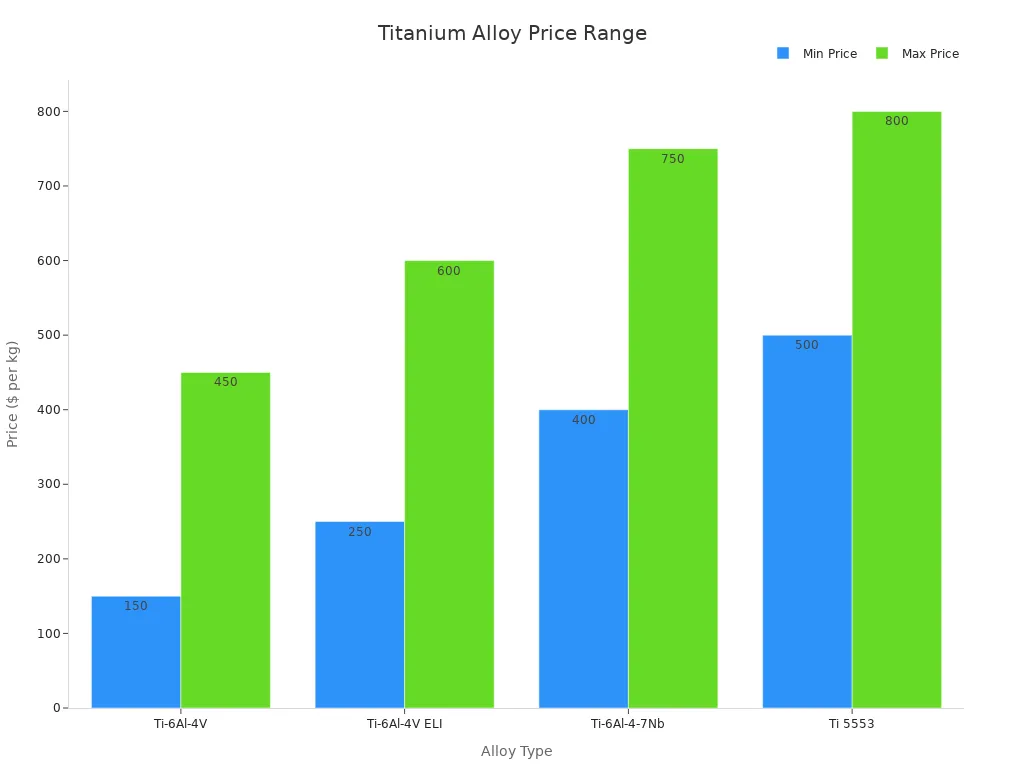
By balancing production costs and material efficiency, you can optimize your investment in titanium alloy powders without compromising on quality.
Ti-6Al-4V stands out as one of the most versatile titanium alloy powders available today. Its exceptional strength-to-weight ratio makes it a preferred choice for industries like aerospace, automotive, and biomedical. This alloy exhibits remarkable corrosion resistance due to its stable oxide layer, ensuring durability in harsh environments. Additionally, its biocompatibility makes it ideal for medical implants and devices.
Studies validate its performance across various applications. For instance:
Moreover, advancements in machine learning have enabled the optimization of Ti-6Al-4V’s porosity, strength, and ductility. These developments ensure that you can achieve consistent performance tailored to your specific industrial needs.
Ti-6Al-4V powder is typically produced using gas atomization or plasma atomization techniques. Gas atomization ensures a uniform particle size distribution, while plasma atomization produces highly spherical particles with excellent flowability. Both methods result in powders suitable for additive manufacturing and other high-precision applications.
You’ll find Ti-6Al-4V widely used in aerospace for manufacturing lightweight yet strong components like turbine blades and structural parts. In the medical field, it’s a go-to material for implants such as hip joints and dental fixtures. Its compatibility with 3D printing technologies also makes it indispensable for prototyping and producing complex geometries.
Grade 5 Titanium Alloy, often synonymous with Ti-6Al-4V, offers a unique combination of mechanical strength and corrosion resistance. Its tensile strength exceeds 900 MPa, making it suitable for high-stress applications. The alloy’s excellent fatigue resistance ensures long-term reliability, even under cyclic loading conditions.
Key production metrics further highlight its reliability:
| Metric | Description |
|---|---|
| Particle Size | Distribution between 15-45 microns allows dense packing and good flow. |
| Morphology | Spherical powders spread evenly, pack densely, and flow smoothly. |
| Flowability | Measured by factors like angle of repose, Hausner ratio, and Hall flowmeter funnel tests. |
| Microstructure | Alloy composition and production method determines the alpha, alpha-beta, or beta microstructures. |
| Oxygen/Nitrogen Content | Higher levels increase brittleness and porosity; specify maximum levels below 0.20%. |
These attributes make Grade 5 Titanium Alloy a reliable choice for industries requiring precision and durability.
Grade 5 Titanium Alloy powder is primarily produced through gas atomization. This method ensures a consistent particle size and spherical morphology, which are critical for applications like additive manufacturing. The powder’s low oxygen and nitrogen content further enhances its mechanical properties, reducing brittleness and improving overall performance.
You’ll see Grade 5 Titanium Alloy used extensively in aerospace for components like landing gear and engine parts. Its corrosion resistance also makes it suitable for marine and chemical processing industries. In the medical sector, it’s a top choice for surgical instruments and implants due to its biocompatibility and wear resistance.
Ti-6Al-2Sn-4Zr-2Mo, often referred to as Ti6242, excels in high-temperature environments. Its superior plastic deformation capacity at temperatures up to 620°C makes it ideal for aerospace and defense applications. Compared to Ti-6Al-4V, Ti6242 offers enhanced mechanical performance, particularly in demanding thermal conditions.
| Alloy | Temperature Range (°C) | Mechanical Performance Comparison |
|---|---|---|
| Ti-6Al-2Sn-4Zr-2Mo | 25–620 | Superior plastic deformation capacity at high temps |
| Ti-6Al-4V (Ti64) | 25–620 | Inferior performance compared to Ti6242 |
| Cast Ti-6Al-2Sn-4Zr-2Mo | 25–620 | Lower mechanical performance than Ti6242 |
This alloy’s ability to maintain structural integrity under extreme conditions ensures reliability in critical applications.
Ti6242 powder is produced using advanced atomization techniques, such as plasma atomization. This process creates highly spherical particles with minimal impurities, ensuring optimal performance in high-temperature environments. The powder’s fine particle size distribution enhances its suitability for additive manufacturing and other precision applications.
You’ll find Ti6242 widely used in aerospace for components like jet engine parts and turbine blades. Its high-temperature resistance also makes it a preferred material for defense applications, including missile systems. Additionally, its durability and strength make it suitable for high-performance automotive components.
KYHE Tech continues to lead the industry in titanium alloy powder innovation. By leveraging cutting-edge production methods and a commitment to sustainability, KYHE Tech ensures that you receive high-quality powders tailored to your industrial needs. Visit KYHE Tech’s website to explore their full range of titanium alloy powders and learn how they can support your projects.
Advancements in atomization techniques have revolutionized the production of titanium alloy powders. Gas and water atomization methods now deliver powders with improved consistency and quality. These innovations are critical for industries like aerospace and automotive, where precision and reliability are non-negotiable.
| Evidence | Description |
|---|---|
| Technological Advancements | Innovations in water and gas atomization have improved the quality and consistency of alloy powders, crucial for aerospace and automotive applications. |
| Sustainability Emphasis | The recycling and repurposing of materials in atomized powder production align with global sustainability efforts, promoting resource optimization and waste reduction. |
The life cycle assessment (LCA) of metal powder production also plays a vital role. It helps you identify environmental impact hotspots and optimize energy consumption during production. These advancements ensure that titanium alloy powders meet the highest standards while minimizing their ecological footprint.
Recycling has become a cornerstone of titanium alloy powder production. By repurposing scrap titanium, manufacturers reduce waste and conserve resources. This approach aligns with global sustainability goals and lowers production costs. Between 2019 and 2023, the titanium scrap recycling market grew at a rate of 6.2%, reaching a value of $2,728.8 million by the end of 2023. Projections indicate a CAGR of 6.6% from 2024 to 2034, highlighting the growing importance of sustainable practices in the industry.
The aerospace sector continues to drive demand for titanium alloy powders. In 2023, aerospace applications accounted for over 40% of the market revenue. Lightweight and fuel-efficient aircraft components rely heavily on these powders. You’ll find them in turbine blades, structural parts, and other critical components. Their high strength-to-weight ratio and corrosion resistance make them indispensable for modern aviation.
Titanium alloy powders are equally transformative in the medical field. They represented approximately 25% of the market share in 2023, driven by the rising prevalence of chronic diseases and an aging population. These powders are essential for manufacturing implants and surgical instruments. Their biocompatibility ensures seamless integration with human tissue, while their durability enhances the longevity of medical devices. This makes them a reliable choice for improving patient outcomes.
Additive manufacturing, or 3D printing, has seen widespread adoption across industries. Titanium alloy powders play a pivotal role in this shift. Their spherical shape and consistent quality make them ideal for creating complex geometries with high precision. As industries embrace this technology, you can expect the demand for these powders to grow exponentially.
The shift toward eco-friendly materials is reshaping the titanium alloy powder market. Recycling initiatives and sustainable production methods are gaining traction. By 2023, the titanium scrap recycling market had already reached significant milestones, and its projected growth underscores the industry’s commitment to sustainability. These trends not only reduce environmental impact but also make titanium alloy powders more accessible and cost-effective for various applications.
In 2025, titanium alloy powders like Ti-6Al-4V, Grade 5, and Ti-6Al-2Sn-4Zr-2Mo stand out for their exceptional performance across industries. You can rely on their lightweight strength, corrosion resistance, and adaptability for applications in aerospace, medical, and additive manufacturing. KYHE Tech leads the way with innovations in powder metallurgy, offering customized blends and sustainable solutions. To adopt these materials effectively, focus on evaluating properties, production methods, and cost-efficiency. Advanced technologies, such as binder jetting and digital design tools, further enhance their industrial potential while promoting sustainability.
Titanium alloy powders combine lightweight strength, corrosion resistance, and biocompatibility. These properties outperform many traditional materials like steel or aluminum, especially in aerospace, medical, and additive manufacturing applications.
Evaluate your application’s needs. Focus on mechanical properties like tensile strength, chemical resistance, and cost-effectiveness. For example, Ti-6Al-4V suits aerospace, while Ti-6Al-2Sn-4Zr-2Mo excels in high-temperature environments.
Yes, especially when manufacturers use recycled titanium scrap. Recycling reduces waste and production costs while aligning with global sustainability goals. Many companies now prioritize eco-friendly production methods.
Absolutely! Their spherical shape and consistent quality make them ideal for additive manufacturing. You can create complex geometries with high precision, making them perfect for aerospace, medical, and automotive industries.
Costs vary by alloy type, particle size, and production method. Ti-6Al-4V ranges from $150 to $450 per kilogram. Bulk orders and recycled materials can reduce expenses.
Ti-6Al-4V offers an excellent strength-to-weight ratio, corrosion resistance, and biocompatibility. It’s versatile, making it suitable for aerospace, medical implants, and 3D printing applications.
Advanced atomization methods, like gas or plasma atomization, produce highly spherical particles with minimal impurities. These techniques ensure better flowability and consistency, crucial for high-precision applications.
Aerospace, medical, and automotive industries gain the most. Aerospace uses them for lightweight components, medical fields for implants, and automotive for fuel-efficient parts.
Tip: Always consult with your supplier to match the powder’s properties to your specific industrial needs.
